.png) October 8, 2026
October 8, 2026
.png) In-Gas Team
In-Gas Team
.png)
GIS Commissioning SF₆ - Why Gas Handling Is the Most Critical Phase
A GIS installation can pass mechanical checks and still enter service with a hidden weakness: gas compartments that were not evacuated, filled, or tested correctly. During GIS commissioning, SF₆ becomes part of the equipment’s insulation system, so contamination, residual moisture, incorrect pressure, or an undetected leak can affect dielectric performance from day one.
That makes gas handling one of the most sensitive stages in gas-insulated switchgear commissioning. The work requires controlled evacuation, verified gas quality, precise filling, leak testing, and traceable documentation. Here is what happens during this phase and why each step matters to the asset’s long-term reliability.
What Is GIS Commissioning, and Where Does Gas Handling Fit?
GIS commissioning verifies that newly installed gas-insulated switchgear is assembled correctly and ready for safe energization. It typically follows installation and assembly, then moves through mechanical inspections, electrical testing, gas processing, control-system verification, and final acceptance.
Gas filling sits at the center of that process because the insulating medium directly affects the GIS’s electrical integrity. Before a compartment can be placed into service, it must be evacuated of air and moisture, filled to its specified insulating gas density or pressure, and leak-checked.
The scope changes considerably with the equipment. Medium-voltage switchgear may be hermetically-sealed and contain relatively small gas quantities, limiting the field work required. A 220kV GIS substation, by contrast, can contain multiple large, segregated gas compartments that must be evacuated and filled individually.
The filling sequence, equipment capacity, testing requirements, and documentation must therefore reflect the GIS manufacturer, type model and confirm the assembly, installation and commissioning results meet the OEM requirements.
Why SF₆ Is Used in Gas-Insulated Switchgear
SF₆ has high dielectric strength and effective arc-quenching properties. These characteristics allow high-voltage conductors and switching components to be enclosed within compact, grounded metal compartments.
The result is a smaller installation footprint and protection from external contaminants and weather. According to CIGRE, GIS technology has been widely used since the 1960s, and Technical Brochure 513 draws on more than 20,000 units across 24 countries.
However, the same gas that enables compact insulation requires disciplined management. The U.S. EPA’s overview of SF₆ in gas-insulated substations explains that gas can be released as an emission during gas handling associated with installation, maintenance, servicing, and decommissioning. Commissioning must therefore protect both gas quality and containment.
The GIS Gas Filling Procedure, Step by Step
The GIS commissioning SF₆ sequence is not simply connecting a cylinder and opening a valve. Each stage prepares the compartment for the next, and shortcuts early in the process can undermine the final result. Here are the stages of the GIS gas filling procedure.
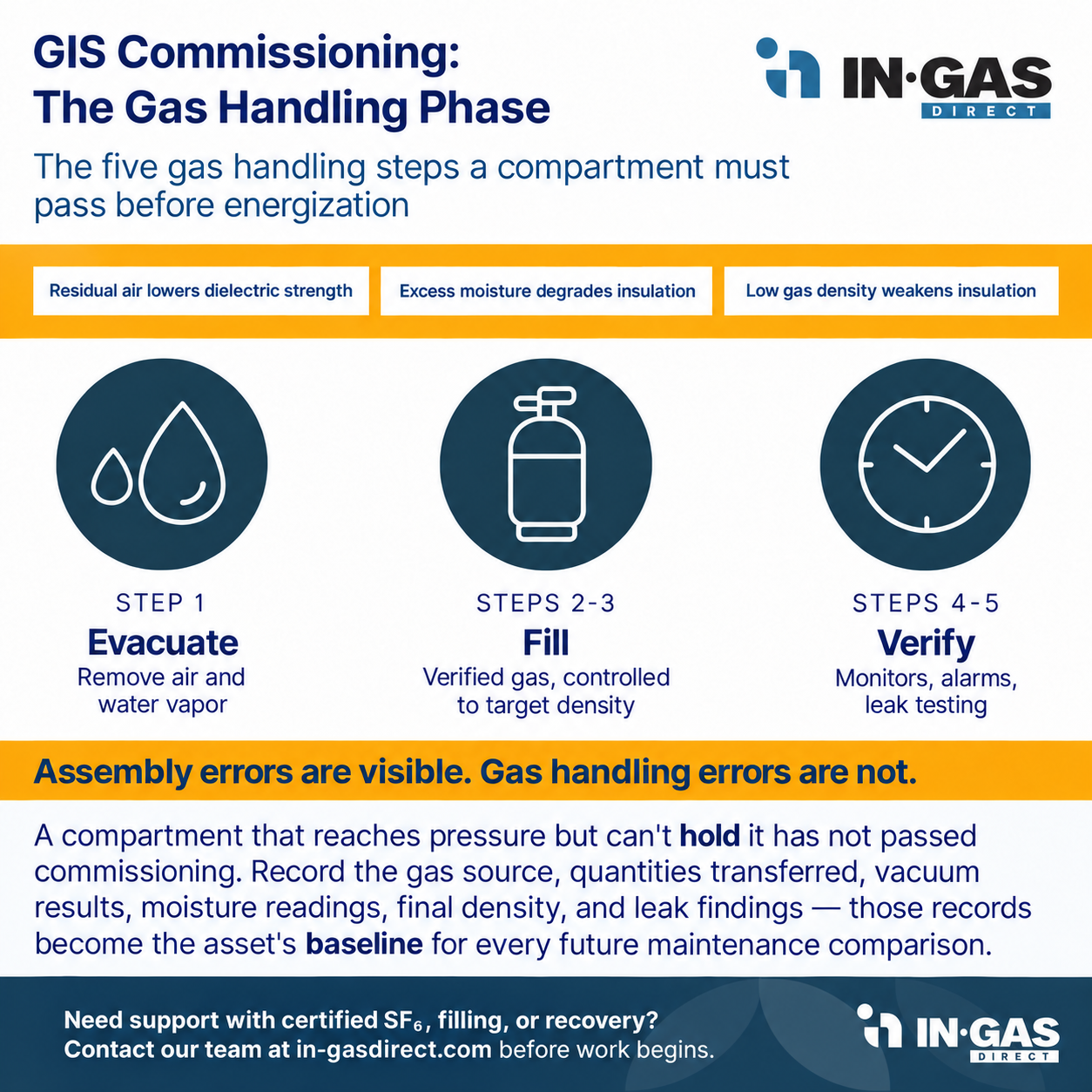
1. Pre-Filling Inspection and Vacuum Evacuation
Technicians first confirm that assembly work is complete, internal components are ready, and compartment seals, flanges, and gas connections have been correctly installed. Hoses and service equipment should also be clean, dry, SF₆-compatible, and securely connected.
The compartment then undergoes evacuation. Removing air, water vapor, and other residual gases creates the conditions required for filling with clean insulating gas.
The personnel performing the gas handling procedures should refer to the evacuation target blank-off pressure and vacuum loss duration provided by the OEM specification. Reaching the target blank off pressure (vacuum pressure) is only part of the verifications required. The compartment's behavior after isolation can also reveal leakage or continued moisture release from internal surfaces.
2. Moisture and Purity Verification
Moisture can reduce insulation performance and contribute to insulating gas degradation during arcing events. Therefore technicians must verify gas-supply quality before gas handling begins and, where required, test the compartment gas after filling. In most cases an analysis of the gas quality should be performed 24 to 48 hours post insulating gas filling.
Acceptable values depend on the equipment manufacturer requirements and gas specification. The correct acceptance criteria is the one established by the OEM as noted in the equipment documentation and commissioning plan.
3. Controlled Gas Filling and Pressure Setting
After evacuation is completed , technicians introduce SF₆ through calibrated gas-handling equipment. Filling must be controlled to avoid contamination, unnecessary emissions, and incorrect final density.
Technicians monitor the relationship between gas quantity, pressure, and temperature as the compartment approaches its specified filling condition. Because pressure varies with temperature, a general gauge reading cannot always be treated as the final acceptance value. Evaluate the result using the manufacturer’s reference conditions or prescribed correction method.
Reliable, documented SF₆ supply is equally important. Introducing gas of unknown purity or moisture content can compromise a compartment before energizing the substation.
4. Density-Monitor Calibration and Functional Checks
Once the compartment reaches its required gas pressure or density, the team checks the density monitor, pressure indication, and alarm contacts against the commissioning requirements. Low-density alarm and lockout functions may also need verification.
After energization, these devices become the operating team’s early warning system. An incorrect setting can create nuisance alarms or, more seriously, delay the detection of gas pressure loss.
5. Post-Filling Leak Detection
The team checks flanges, valves, fittings, bushings, and other potential leakage points after filling. The method depends on the project requirements and may include local leak detection, pressure observation, or other approved techniques.
A compartment that reaches pressure but cannot retain it has not passed commissioning. Correct and document leak findings before acceptance, rather than transferring them to the maintenance team as an unresolved issue.
Why Gas Handling Is the Most Critical Commissioning Phase
Assembly errors can often be identified visually or through mechanical testing. Gas-handling errors may remain concealed inside an apparently normal compartment.
Residual air can lower dielectric strength. Excess moisture may affect insulation performance. Incorrect density can reduce the designed withstand capability, while contamination may complicate later testing and servicing. A small leak can also become a recurring source of gas loss, alarms, and unplanned intervention.
Correcting these problems after energization is far more disruptive. The affected bay may need to be isolated, the gas recovered, the compartment opened or repaired, and the evacuation and filling sequence repeated. Careful SF₆ handling during commissioning protects both the initial energization schedule and the asset’s future maintenance burden.
SF₆ Gas Safety During Commissioning
Unused SF₆ is nonflammable and generally stable under normal conditions, but it is 5 times denser than air. A release can displace oxygen in enclosed or low-lying areas, so ventilation, atmospheric awareness, and site controls are important.
Gas exposed to electrical arcing may also contain hazardous decomposition products. Technicians should follow the applicable risk assessment, use suitable PPE, and avoid treating used gas as equivalent to clean supply gas.
Personnel qualifications and regulatory obligations vary by jurisdiction. The EU regulations on SF₆ switchgear servicing requirements, for example, requires appropriately certified personnel for installation, maintenance, gas recovery and decommissioning activities involving SF₆.
When gas must be recovered, the process requires the gas to be recovered into cylinders using specifically designed SF₆ gas-recovery equipment. Venting is not an acceptable substitute for SF₆ recovery.
Common GIS Installation and Commissioning Mistakes
The most damaging mistakes are often simple process failures:
- Filling before the required vacuum and hold checks are complete
- Filling over non-SF₆ shipping gas (i.e. N2 or O2)
- Using, contaminated, or poorly maintained hoses and equipment
- Skipping gas-quality verification
- Applying pressure targets without temperature correction
- Failing to verify density-monitor alarms and contacts
- Treating leak detection as optional
- Recording only the final pressure, with no gas mass or quality data
Each shortcut removes evidence that the compartment is ready for service.
Better Gas Management for GIS Maintenance and Commissioning
A well-documented GIS commissioning SF₆ program starts with a plan that identifies every compartment, its gas capacity, target filling condition, and acceptance criteria. Teams should use calibrated equipment, verify gas certificates, and maintain records of the gas source, quantities transferred, vacuum results, moisture and purity readings, final density, and leak-test findings.
Those records become the asset’s baseline. Years later, maintenance teams can compare new measurements against the commissioning data instead of trying to reconstruct the GIS’s starting condition.
Disciplined gas handling is therefore not merely the last step before energization. It is the point at which careful installation becomes a dependable operating asset. For support with certified SF₆, evacuation, filling, recovery, or commissioning gas management, contact our team to define the equipment, gas, and field-service requirements before work begins.

In-Gas Team
About the In-Gas Team: The In-Gas blog is authored by a collaborative team of industry experts, technicians, and content partners. Our contributors bring hands-on experience from the field, deep knowledge of SF₆ and alternative gas management, and insight into evolving compliance and sustainability standards. Whether written by our service technicians, training specialists, or SEO/content partners like Hirudo, every post reflects our shared commitment to environmental stewardship, utility reliability, and zero-emission gas handling.