November 4, 2026
 In-Gas Team

SF₆ Gas Disposal: When Venting Is Illegal and Why Reconditioning Comes First
A typical waste company may accept a used cylinder, but it likely lacks the equipment or authorization to manage the sulfur hexafluoride inside. Proper SF₆ gas disposal is a controlled process: recover the gas, evaluate its condition, recycle or recondition it when practical, and send only unusable material for destruction.
Each step must also be documented. Without gas recovery records, cylinder tracking, and final disposition paperwork, an equipment owner may struggle to demonstrate that the gas was handled responsibly, or that it was not released to the atmosphere.
Why Venting SF₆ Is a Serious Environmental Problem
SF₆ is nonflammable, chemically stable, and effective as an insulating and arc-quenching gas. Those same stability characteristics become an environmental problem when it enters the atmosphere.
Current research estimates its 100-year warming potential at approximately 24,300 times that of carbon dioxide, while published estimates of its atmospheric lifetime range from hundreds to thousands of years. This exceptionally high SF₆ global warming potential means even a comparatively small release can carry a significant climate impact.
It is also important to distinguish among different types of releases:
- Intentional venting: Deliberately releasing recovered or stored gas instead of containing it.
- Equipment leakage: Gas escaping through seals, fittings, or aging equipment.
- Accidental release: An unplanned loss caused by equipment failure or a handling incident.
- Maintenance or decommissioning emissions: Gas lost while opening, repairing, retiring, or dismantling equipment.
The cause affects how regulators evaluate the event. Intentional disposal by venting is especially difficult to defend when established recovery options are available.
Is SF₆ Venting Illegal in the United States?
It depends on where you operate, but venting is never a safe assumption. No single federal rule bans every SF₆ release, yet state rules, reporting obligations, and permits can make intentional venting a violation.
At the federal level, the EPA’s Greenhouse Gas Reporting Program requires qualifying electric power systems to quantify and report SF₆ and other fluorinated greenhouse gas emissions under 40 CFR Part 98, Subpart DD. Covered organizations must maintain supporting records for their calculations and reports. Subpart DD is primarily a reporting framework; it is not a universal federal venting ban.
State rules may go further. The California Air Resources Board regulates SF₆ emissions from gas-insulated equipment. Its requirements include emission limits, recordkeeping, reporting, and restrictions intended to reduce reliance on SF₆. New York has also adopted rules that phase down SF₆ use in gas-insulated equipment and establish owner requirements.
Other environmental, waste, permit, and occupational requirements may also apply. Equipment owners should therefore assess both federal obligations and state rules in every state where they handle their equipment or recovered gas.
Who Enforces SF₆ Emissions Regulations?
Enforcement responsibility generally follows the SF₆ gas disposal regulations:
- The U.S. Environmental Protection Agency administers federal greenhouse gas reporting requirements.
- CARB enforces California’s SF₆ rules for gas-insulated equipment.
- The New York State Department of Environmental Conservation administers New York’s applicable requirements.
- Other state environmental agencies may enforce air, waste, or facility-specific rules.
These requirements have resulted in real penalties. CARB reports that Southern California Edison paid $350,000 to settle alleged violations of California’s SF₆ regulation. The agency has also pursued other gas-insulated equipment owners for violations of emission limits, reporting, and recordkeeping.
The Southern California Edison settlement shows why owners need defensible inventory and handling records under SF₆ emissions regulations, not informal disposal arrangements.
Disposal Should Not Automatically Mean Destruction
Evaluate recovered SF₆ before designating it as waste. Depending on its condition, the gas may be suitable for:
- On-site recovery and reuse
- Recycling to remove particles, oil, and moisture
- Reconditioning to restore the gas to an applicable reuse specification (including purity)
- Destruction when contamination or other conditions make reconditioning impractical
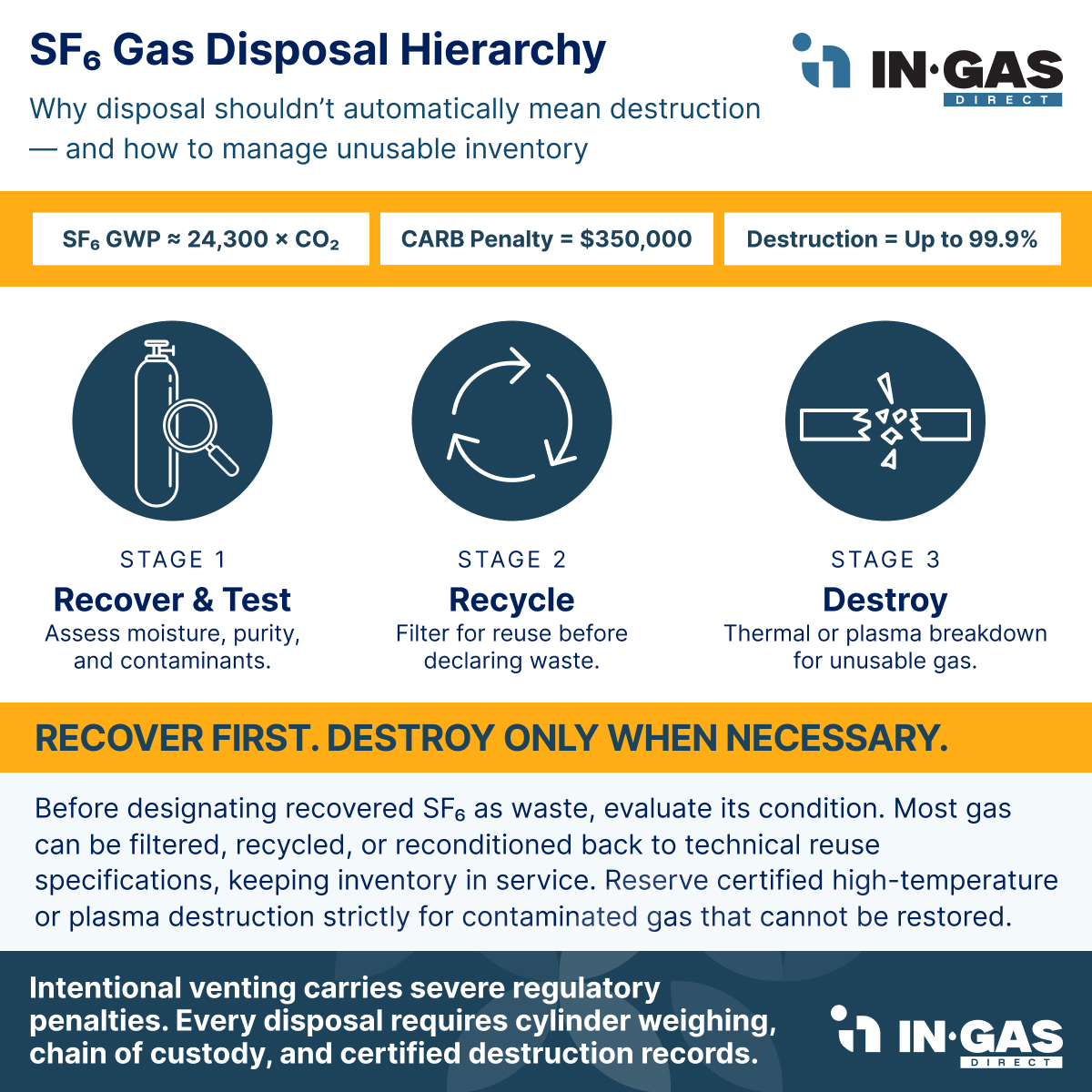
This hierarchy keeps usable gas in circulation and reduces demand for newly manufactured SF₆. It can also lower disposal volumes and preserve the economic value of recovered inventory.
A qualified service provider can test the gas and determine whether SF₆ recovery, recycling, and disposal is the appropriate route. Where gas remains recoverable, SF₆ reconditioning may return it to a verified specification rather than sending it for destruction.
If Destruction is Truly Necessary: What to Require
Destruction should be reserved for gas that testing shows cannot be reconditioned.
“Certified destruction” is a common commercial term, but gas insulated equipment owners should not assume it refers to a single, universal U.S. government certificate. What matters is whether the provider can demonstrate a controlled, traceable, and verifiable process.
A defensible destruction workflow should include:
- Recovery without intentional atmospheric release
- Measurement or weighing of the gas collected
- Approved, sealed, and traceable cylinders
- Unique cylinder or container identification
- Chain-of-custody records for every transfer
- Transportation to an authorized destruction facility
- A controlled destruction process with appropriate management of by-products
- Final documentation identifying the quantity and disposition of the gas
The resulting certificate or destruction record should be supported by actual transaction data. A generic statement that material was “properly disposed of” offers little assurance unless it identifies the gas quantity, cylinder, facility, date, and destruction method.
How SF₆ Can Be Destroyed
Because SF₆ is extremely stable, destruction requires specialized technology rather than ordinary combustion or waste treatment.
One method under investigation uses plasma to break the molecule apart under controlled conditions. In a published microwave-plasma study, researchers tested diluted SF₆ in nitrogen with water vapor and achieved destruction and removal efficiencies as high as 99.9% under the reported experimental conditions.
The study demonstrates the technical potential of plasma treatment, but its results should not be treated as a guaranteed performance rate for every commercial facility or gas stream.
High-temperature thermal processes may also be used when the facility is designed to control operating conditions and safely manage fluorine- and sulfur-containing by-products. In either case, the destruction facility should be able to document its process, authorization, and treatment of residual materials.
However, it should be noted that destruction of SF₆ can contribute to greater emissions than reconditioning. Refer to IPCC AR4 reports and DILO article on SF6 gas reconditioning.
SF₆ Disposal Documentation Checklist
Before closing a project, request and retain:
- The starting and recovered gas quantities
- Scale tickets or other measurement records
- Cylinder serial numbers
- Gas analysis results, if testing was performed
- Shipping and receiving documentation
- Chain-of-custody records
- The identity and location of the receiving facility
- The treatment or destruction method
- A final certificate or disposition record
- Measuring equipment calibration certificates
- Any documents required by applicable federal or state rules
These records help demonstrate that the SF₆ gas disposal process was properly controlled, reconcile the facility’s SF₆ inventory, support regulatory reporting and provide evidence during an audit or environmental review.
How to Choose an SF₆ Disposal Provider
Ask prospective providers specific questions before transferring gas:
- Will you test the gas before recommending destruction?
- Can you separate reusable SF₆ for recycling or reconditioning?
- How is gas weighed and reconciled?
- How are cylinders tracked during transportation?
- Which facility will receive the gas?
- What destruction technology does that facility use?
- How are hazardous by-products controlled?
- What final documentation will we receive?
- Can you support our reporting and record-retention requirements?
A provider offering complete SF₆ gas handling support should be able to explain the entire route from equipment recovery to final disposition, not merely arrange cylinder pickup. One should note that dilution of contaminated SF₆ with virgin SF₆ is not a safe and proper reconditioning technique and should be avoided. The reason is because the contamination will continue to exist and handling techniques can create emissions as well as further contamination. The introduction of virgin SF₆ to inventory, even though dilution contributes to higher global emissions than proper reconditioning techniques.
Recover First, Destroy Only When Necessary
Recovery is the essential first step in responsible disposal. It prevents deliberate release, allows gas testing, and keeps reuse options open. Reserve destruction for SF₆ that cannot reasonably be returned to service.
Need to dispose of SF₆ or determine whether recovered gas can be reused? In-Gas Direct provides gas analysis, recovery support, and reconditioning, with documentation that keeps every cylinder traceable. When gas truly can’t be returned to service, we can help you route it responsibly. Speak with an expert.

In-Gas Team
About the In-Gas Team: The In-Gas blog is authored by a collaborative team of industry experts, technicians, and content partners. Our contributors bring hands-on experience from the field, deep knowledge of SF₆ and alternative gas management, and insight into evolving compliance and sustainability standards. Whether written by our service technicians, training specialists, or SEO/content partners like Hirudo, every post reflects our shared commitment to environmental stewardship, utility reliability, and zero-emission gas handling.