.png) September 15, 2026
September 15, 2026
.png) In-Gas Team
In-Gas Team
.png)
What "Zero Emissions" SF₆ Gas Handling Actually Means in the Field — And How We Achieve It
“Zero emissions” is easy to print on a website and much harder to achieve in a live substation. Every transfer, hose connection, cylinder change, and equipment opening is a potential release pathway, and closing them takes more than careful technicians.
It takes disciplined SF₆ gas handling, including closed-loop procedures, controlled connections, mass-based gas accounting, and a documented record from start to finish. Here's what we mean by zero-emissions handling in practice, and why the same discipline carries over as fleets move to alternative gases.
Why Even Small SF₆ Emissions Matter
Utilities have used SF₆ extensively in high-voltage equipment because its electrical properties make it an effective insulating and arc-quenching medium. Its environmental properties are far less favorable.
The U.S. EPA puts SF₆'s 100-year global warming potential at approximately 23,500 times that of CO₂. It also persists in the atmosphere for thousands of years. That makes leakage during the lifecycle of gas-insulated switchgear more than a maintenance issue. It's an environmental and compliance issue.
The U.S. EPA identifies equipment leak detection and repair, improved gas handling, recycling, and the adoption of alternative technologies among important SF₆ mitigation opportunities.
For utilities, that puts scrutiny on what happens during installation, commissioning, maintenance, repair, gas recovery, and decommissioning. The challenge is that field conditions aren't a laboratory.
Technicians may be working around aging equipment, varying pressures, multiple cylinders, long hoses, contaminated gas, and tight outage windows. A credible zero-emissions strategy has to account for those realities.
What Does "Zero Emissions" Mean in SF₆ Gas Handling?
In practical field terms, zero-emissions handling means designing the process to prevent intentional SF₆ releases and minimize avoidable losses at every transfer point, while measuring and documenting the gas inventory.
Four operational pillars make that possible.
1. Closed-Loop Gas Recovery: Recover It, Don't Release It
The first principle is straightforward: gas that can be recovered should not be vented.
During maintenance or decommissioning, SF₆ must often be removed from a circuit breaker, GIS compartment, or other high-voltage asset. A closed-loop recovery process transfers that gas from the equipment into suitable storage rather than releasing it into the atmosphere.
The recovery unit lowers the pressure inside the equipment and transfers the SF₆ into a gas cylinder or other approved storage vessel. Depending on the service procedure and equipment, evacuation can continue to a specified final recovery pressure to minimize residual gas.
The recovered SF₆ can then be analyzed to determine whether it meets the applicable requirements for reuse or requires further processing. This is a core part of responsible SF₆ gas management and zero-emission field handling.
The objective isn’t merely to get the gas out of the equipment. It’s to maintain control of where that gas goes next and account for its movement throughout the process. On-site, this is exactly what our on-site substation SF₆ services are built around.
2. Emission-Reducing Couplings: Control the Weakest Point
A sophisticated recovery unit will not prevent emissions if gas escapes at the connection. Specifically designed insulating gas handling hoses, valves, fittings, and couplings are therefore critical components of an emission-preventive handling system.
Traditional connections can trap a small amount of pressurized gas between valves. When the hose is disconnected, that trapped volume may escape- the familiar "puff" that can seem insignificant during a single operation. Across repeated servicing events, those small releases add up.
Self-sealing valves, pressure-tight gas fittings, and low-loss or emission-reducing coupling designs help minimize this risk. The connection remains sealed during attachment and removal, reducing the volume of gas that can escape during hose changes.
Proper procedures matter just as much as the hardware. Check connections for integrity, evacuate hoses as required, and recover residual gas before disconnecting valves and hoses whenever equipment and procedure allow.
In real-world field conditions, these connection points can be among the most important areas to control because even small, repeated losses can undermine a zero-emission SF₆ gas-handling strategy.
3. Gas Weighing: Because "We Recovered It" Isn't a Measurement
How does a gas handling specialist demonstrate that gas was actually accounted for? By measuring it. Gas weighing provides a mass-based record of how much SF₆ enters or leaves storage during servicing.
Weigh the cylinder before the transfer and again afterward. Combined with equipment inventory records and other relevant measurements, those values help establish a mass balance for the operation.
This matters because pressure alone doesn't provide the same direct measure of gas mass. Temperature affects gas pressure, and a pressure reading cannot explain where every kilogram/pound of SF₆ went.
Accurate weighing helps answer the questions compliance teams actually care about:
How much gas was removed? How much was transferred? How much was returned? Is there an unexplained difference? That last question matters.
If the numbers don't reconcile within the expected measurement uncertainty, investigate the discrepancy rather than logging it as “zero”.
For zero-emission SF₆ gas handling, accountability requires more than completing the recovery process. It requires demonstrating what happened to the gas. For the full mass-balance methodology and EPA Subpart DD reporting requirements, see our guide to SF₆ emissions accounting for power utilities.
4. Document Every Transfer
Measurement without documentation isn't enough. Every significant SF₆ movement should leave a traceable and auditable record.
Depending on the scope of work and applicable requirements, that record can include information such as equipment identification, gas quantities transferred or recovered, cylinder identification, gas condition, dates, service activities, and final disposition.
That creates traceability across the gas lifecycle. For an environmental compliance officer facing an audit, the difference is significant.
Rather than relying on a technician’s statement that no gas was released, the utility has a documented history showing where the gas came from, how much was handled, where it went, and what happened to it afterward.
There is a documented history showing where the gas came from, where it went, how much was handled, and what happened to it afterward. For on-site SF₆ services, that paper trail is an important part of responsible gas management.
Digital gas-management platforms such as Direct-Track™ can further improve traceability by consolidating equipment records, cylinder inventory, transfer quantities, and service documentation into a single system.
What Happens to Contaminated SF₆?
Recovery doesn't automatically mean reuse. SF₆ removed from electrical equipment may contain moisture, air, decomposition products, or other contaminants. Evaluate its condition before returning it to service.
Gas that can be restored to the required quality may be processed or reclaimed for reuse, where appropriate. Responsible zero-emission handling doesn’t end at the edge of the substation.
SF₆ that cannot be brought back to an acceptable specification should remain contained and be transferred through an appropriate waste-management or destruction pathway in accordance with applicable regulations. Don't vent it just because it's no longer useful.
This distinction is important: recovery, reclamation, recycling, and destruction are not interchangeable terms. The appropriate path depends on gas quality and applicable technical and regulatory requirements. We break down when each pathway applies in SF6 recovery, recycling & disposal: key differences.
How Zero-Emission Handling Applies to SF₆ Alternatives
The industry's long-term strategy extends beyond preventing emissions from existing SF₆ assets—it's also about reducing dependence on SF₆ itself. Utilities and manufacturers are evaluating alternatives including vacuum interruption, clean-air systems, and fluoronitrile-based mixtures such as C4-FN, depending on voltage class and application.
But moving to an SF₆ alternative doesn't eliminate the need for disciplined gas handling. A lower-GWP gas shouldn't become an excuse for lower handling standards. Take C4-FN: it's typically used in a carefully formulated mixture whose composition affects dielectric and thermodynamic performance, so technicians must preserve or verify the specified composition rather than simply manage a single gas—making controlled filling, recovery, storage, and verification even more important.
The principle stays the same, even if the procedure doesn't. SF₆ and alternative gases have different physical properties, exposure considerations, and equipment requirements, so hoses, seals, recovery units, storage vessels, and analyzers must be compatible with the gas being handled. The core discipline carries over regardless of the medium: containment, controlled transfer, recovery, suitable equipment, and gas accountability throughout the service lifecycle.
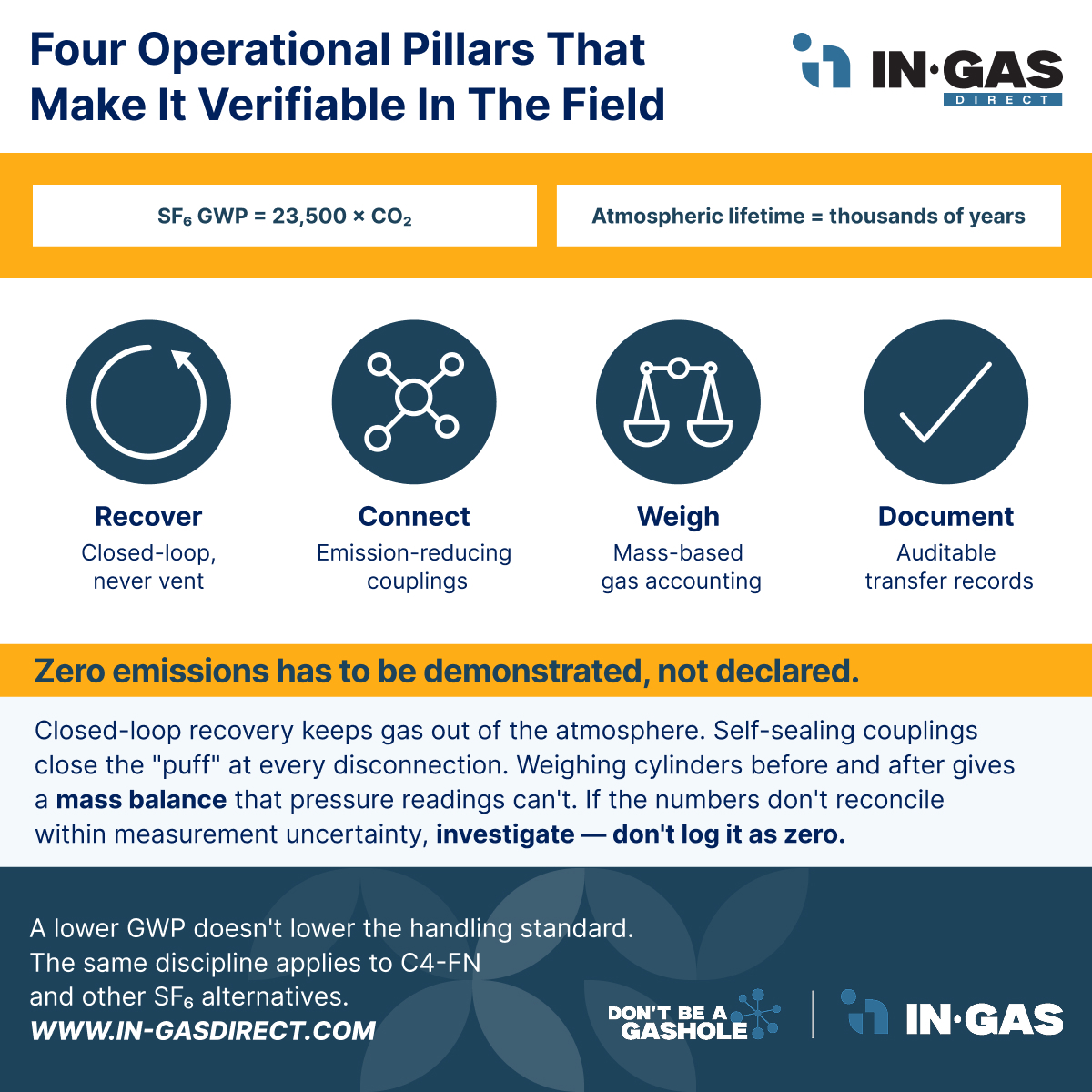
Zero Emissions Has to Be Demonstrated, Not Declared
Zero-emission handling is not simply a claim on a service report. It must be supported by controlled procedures, reliable measurements, and records that account for the gas throughout the service process.
For utilities managing GIS substations, circuit breakers, and other high-voltage assets, that comes down to four things: know where the gas is, know how much you handled, prevent intentional releases, and keep the records to prove it.
A credible zero-emissions approach combines closed-loop recovery, emission-reducing connections, accurate gas weighing, and complete documentation. Together, these practices help utilities account for their gas, minimize avoidable releases, investigate discrepancies, and maintain a defensible service record.
In-Gas Direct applies these principles throughout SF₆ and alternative gas handling—from filling and recovery through testing, storage, and final disposition. If you need gas movements documented to an auditable standard, contact our team to discuss your equipment and service requirements.

In-Gas Team
About the In-Gas Team: The In-Gas blog is authored by a collaborative team of industry experts, technicians, and content partners. Our contributors bring hands-on experience from the field, deep knowledge of SF₆ and alternative gas management, and insight into evolving compliance and sustainability standards. Whether written by our service technicians, training specialists, or SEO/content partners like Hirudo, every post reflects our shared commitment to environmental stewardship, utility reliability, and zero-emission gas handling.