.png) August 6, 2026
August 6, 2026
.png) In-Gas Team
In-Gas Team
.png)
If your SF₆ numbers don't add up at reporting time, you're not alone. SF₆ emissions have become one of the most closely scrutinized greenhouse gas categories in the power sector — and the margin for error keeps shrinking.
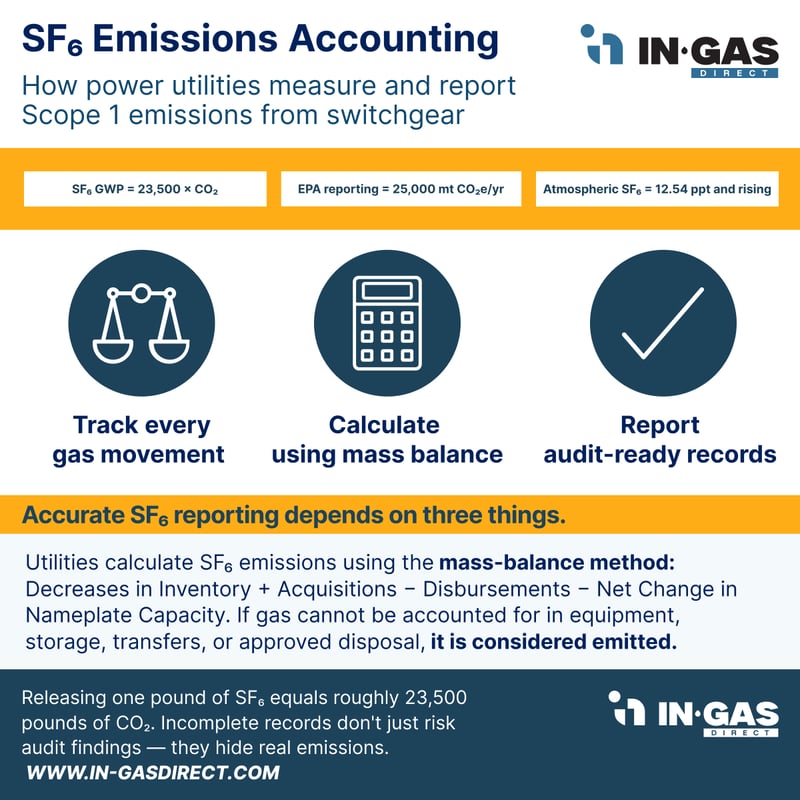
Sulfur hexafluoride (SF₆) is widely used in circuit breakers, gas-insulated switchgear (GIS), and substations because of its exceptional insulating properties. The IPCC categorizes it as a potent greenhouse gas, with a global warming potential (GWP) roughly 23,500 times greater than CO₂ over a 100-year period.
Atmospheric concentrations continue to rise. According to NOAA's Global Monitoring Laboratory, global atmospheric SF₆ concentrations reached 12.54 parts per trillion (ppt) in January 2026, up from 12.03 ppt in January 2025.
For utilities, SF₆ emissions aren't just an environmental concern anymore. They're a compliance issue, an ESG reporting issue, and increasingly, something your board is asking about.
This guide explains how power utilities should measure, calculate, and report SF₆ Scope 1 emissions using the industry-standard mass-balance method, while building a defensible reporting framework that withstands audits and regulatory scrutiny.
Why SF₆ Emissions Matter for Scope 1 Reporting
Under the GHG Protocol, Scope 1 emissions are direct greenhouse gas emissions from sources owned or controlled by an organization.
For electric utilities, SF₆ losses from switchgear and circuit breakers count as fugitive Scope 1 emissions — the gas escapes directly from equipment you own and operate.
Unlike combustion-related emissions, SF₆ losses often occur through:
- Aging seals
- Gasket degradation
- Density monitor leaks
- Equipment servicing activities
- Improper gas handling
- Equipment failures
Because of SF₆'s exceptionally high global warming potential, even relatively small gas losses can create significant greenhouse gas impacts.
How much worse is SF₆ than CO₂?
SF₆ has a global warming potential approximately 23,500 times greater than CO₂ over 100 years. For reference, current GWP values can be found through the UNFCCC's Global Warming Potentials guidance.
Using current GWP values, the release of just one pound of SF₆ can generate approximately 23,500 pounds of CO₂-equivalent emissions.
Bottom line: SF₆ inventory management deserves the same rigor you'd give any other regulated emission source.
For organizations building emissions inventories, EPA's Scope 1 and Scope 2 Inventory Guidance provides useful context on categorizing and reporting direct emissions.
Regulatory Framework: Who Must Report SF₆ Emissions?
Several regulatory frameworks govern SF₆ emissions reporting and reduction efforts.
EPA Greenhouse Gas Reporting Program (Subpart DD)
In the United States, EPA Subpart DD applies to electric power systems whose combined nameplate capacity equals or exceeds 17,820 pounds of SF₆ and other fluorinated greenhouse gases.
Affected entities must calculate annual emissions using the mass-balance methodology and submit reports through the EPA's Greenhouse Gas Reporting Program.
Revised calculation to determine subpart DD applicability
To help ensure that the GHGRP data collected better reflects the emission rates and insulating gases that prevail in the current electric power system industry, EPA replaced the rule using a nameplate capacity threshold (17,820 pounds of SF₆ or PFCs) with an emissions threshold of 25,000 metric tons CO2e per year of F-GHGs.
To calculate their F-GHG emissions for comparison with the threshold, electrical equipment users would use one of two new equations in subpart DD as stated in the rule 40 CFR 98.301, proposed Equations DD-1 and DD-2. (The former Equation DD-1 is redesignated as DD-3).
The proposed changes would require tracking of additional fluorinated gases and the equipment they are contained in.
Essentially, the EPA replaced the nameplate threshold with a calculation method for facilities to estimate total annual GHG emissions for comparison to the 25,000 metric tons of CO2 threshold.
California CARB Requirements
California's Air Resources Board (CARB) imposes additional requirements and annual emission-rate limits for gas-insulated equipment operators.
Utilities operating in California face stricter expectations regarding leak reduction and gas management practices.
Massachusetts MASSDEP
Massachusetts utilities may also be subject to state-specific reporting and emissions management requirements related to SF₆ equipment.
EU F-Gas Regulation
Outside the United States, Regulation (EU) 2024/573 continues the phase-down of fluorinated greenhouse gases and introduces additional restrictions on new SF₆-containing equipment over time.
No matter where you operate, the direction is clear: SF₆ reporting requirements are tightening, not loosening.
The Mass-Balance Method: Industry Standard for SF₆ Accounting
The foundation of SF₆ emissions reporting is the mass-balance method.
Rather than estimating leaks directly from individual assets, utilities calculate emissions based on changes in gas inventory over a reporting period.
The general formula is:
Emissions = (Decreases in Inventory) + (Acquisitions) – (Disbursements) – (Net Change in Nameplate Capacity)
The logic is straightforward.
If gas enters your inventory but cannot be accounted for in equipment, storage, transfers, or approved disposal activities, it is considered emitted.
Required Data Inputs
Accurate calculations require detailed records of:
- Gas purchases
- Cylinder inventories
- Gas returned to suppliers
- Gas sent for recycling or destruction
- Equipment additions and removals
- Nameplate capacity changes
- End-of-year inventory balances
Utilities that maintain incomplete inventory records often struggle during audits because they cannot reconcile gas movements throughout the reporting period.
Common Calculation Errors
Several issues frequently trigger reporting discrepancies:
- Missing cylinder weight records
- Inaccurate beginning or ending inventories
- Failure to track temporary gas transfers
- Omitting decommissioned equipment
- Incorrect nameplate capacity values
- Spreadsheet calculation errors
The best practice is to establish a documented chain of custody for every pound of SF₆ entering or leaving the organization.
Step-by-Step: How to Measure SF₆ Emissions from Switchgear
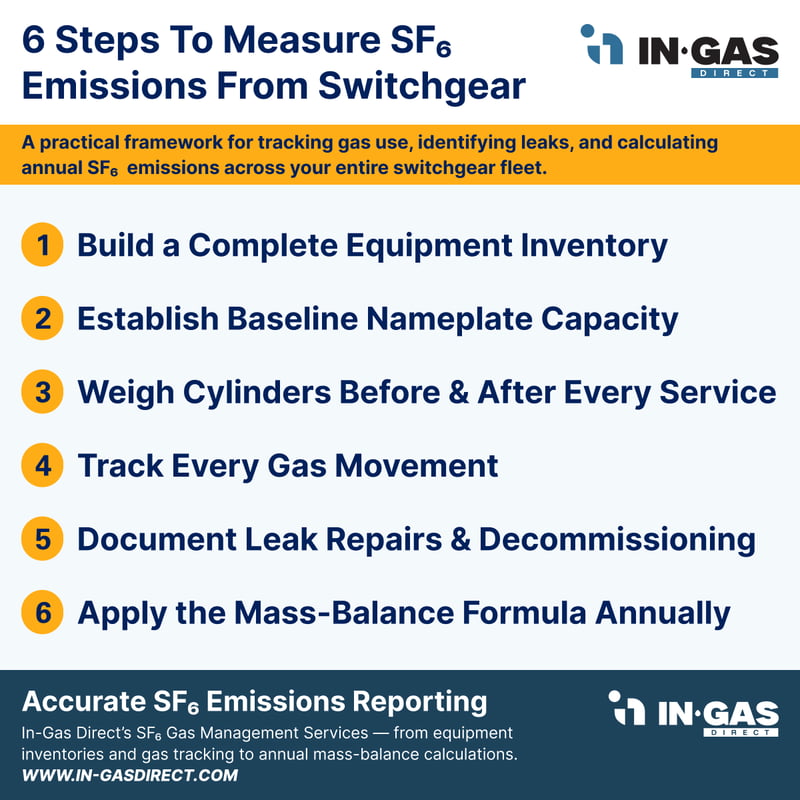
1. Build a Complete Equipment Inventory
Begin by identifying every SF₆-containing asset within your organization.
This includes:
- GIS installations
- Circuit breakers
- Ring main units
- Dead tank breakers
- Live tank breakers
- Gas-insulated substations
Many utilities discover reporting gaps because legacy equipment was never incorporated into a centralized inventory.
2. Establish Baseline Nameplate Capacity
Nameplate capacity refers to the maximum quantity of SF₆ the equipment was designed to contain. This value serves as the baseline for regulatory reporting.
A common misconception is that nameplate capacity equals actual inventory. It does not.
Actual inventory reflects the gas physically present at a given time, while nameplate capacity reflects design specifications.
3. Weigh Cylinders Before and After Every Service Event
Every gas movement should be measured and documented.
Utilities should record:
- Cylinder ID
- Gross weight
- Tare weight
- Net gas weight
- Date
- Technician
- Equipment serviced
Accurate cylinder tracking forms the backbone of the mass-balance method.
Organizations using outsourced gas services should also ensure vendor records are incorporated into their inventory system.
For many utilities, managing this information with paper records or spreadsheets quickly becomes difficult as cylinder inventories grow.
Digital inventory management platforms like Direct-Track™ centralize cylinder data, automate recordkeeping, and provide an audit-ready history of every service event, helping reduce manual errors and simplify compliance.
4. Track Every Gas Movement
Documentation should include:
- Initial fills
- Top-offs
- Gas recoveries
- Transfers between cylinders
- Recycling activities
- Disposal events
Even small unrecorded movements can accumulate into significant reporting discrepancies over time.
Using a centralized tracking system such as Direct-Track™ allows utilities to record every gas movement in one place, maintain a complete chain of custody for SF₆ cylinders, and quickly generate the documentation needed for emissions reporting and audits.
5. Document Leak Repairs and Decommissioning Activities
Leak repairs and equipment retirements affect both inventory calculations and future emissions performance.
Utilities should maintain records of:
- Leak locations
- Gas recovered
- Gas replaced
- Equipment removed from service
- Nameplate capacity changes
6. Apply the Mass-Balance Formula Annually
At the end of the reporting period, consolidate inventory records and perform the annual emissions calculation.
Many organizations perform quarterly reconciliations as a quality-control measure rather than waiting until year-end.
Best Practices to Reduce Emissions
The most effective way to improve SF₆ reporting outcomes is to reduce actual emissions.
Use Zero-Emission Gas Handling Practices
Modern recovery systems can achieve recovery efficiencies approaching 99.99% when properly operated.
Working with qualified providers of SF₆ Gas Handling Services helps ensure gas transfers are performed safely and with minimal emissions.
Conduct Routine Leak Detection
Regular inspections should focus on:
- Flange connections
- Density monitors
- Valves
- Gaskets
- Filling ports
Finding small leaks early is usually far less expensive than responding to significant gas losses later.
Improve Cylinder Management
Cylinder inventory management remains one of the most overlooked aspects of SF₆ accounting.
Regular cylinder maintenance and recertification programs help ensure accurate inventories while maintaining regulatory compliance.
Evaluate Alternative Gas Technologies
Many utilities are exploring lower-GWP alternatives for future installations.
Solutions involving fluoronitrile blends, clean-air technologies, and other alternatives continue to gain traction.
Organizations evaluating next-generation equipment may benefit from learning more about alternative gas handling solutions and infrastructure requirements.
Common Pitfalls in SF₆ Emissions Reporting
Even experienced utilities encounter reporting challenges. Common issues include:
Missing Commissioning and Decommissioning Events
Large gas movements often occur during equipment installation and retirement. Failing to document these activities can distort annual emissions calculations.
Inaccurate Cylinder Records
Poor inventory practices remain one of the leading causes of reporting errors.
Excluding Small Assets
Sub-threshold equipment still contributes to total organizational emissions and should not be ignored.
Spreadsheet Dependency
Manual spreadsheets create opportunities for:
- Data entry errors
- Formula mistakes
- Missing records
- Version-control issues
As reporting requirements become more complex, many utilities are transitioning to dedicated SF₆ tracking platforms.
Building a Defensible Reporting Workflow
Regulators and auditors increasingly expect utilities to demonstrate not only accurate calculations but also reliable processes.
A defensible reporting program should include:
- Digital inventory management
- Audit-ready documentation
- Technician training programs
- Chain-of-custody records
- Standardized gas handling procedures
- Regular internal audits
Organizations that maintain complete records throughout the year typically experience far fewer compliance challenges during reporting season.
In-Gas Direct supports utilities with SF₆ Gas Handling services, cylinder management expertise, alternative gas transition support, and Direct-Track™ inventory management solutions that help organizations improve reporting accuracy and maintain compliance across their SF₆ asset fleet.
Need help tightening up your reporting process? Our team works with utilities on exactly this — reach out, and we'll walk through it with you. Contact us.

In-Gas Team
About the In-Gas Team: The In-Gas blog is authored by a collaborative team of industry experts, technicians, and content partners. Our contributors bring hands-on experience from the field, deep knowledge of SF₆ and alternative gas management, and insight into evolving compliance and sustainability standards. Whether written by our service technicians, training specialists, or SEO/content partners like Hirudo, every post reflects our shared commitment to environmental stewardship, utility reliability, and zero-emission gas handling.