.png) February 24, 2026
February 24, 2026
.png) Lina Encinias
Lina Encinias
.png)
Regulatory scrutiny around SF₆ emissions is increasing, and utilities are under growing pressure to prove that reported data is accurate, auditable, and defensible. In many cases, the biggest source of reporting errors isn’t active SF₆ gas leaks, but incorrect nameplate data that no longer reflects actual gas content.
SF₆ nameplate verification corrects this at the source by aligning reported capacity with real-world conditions. This article explains why nameplate errors occur, how verification works in practice, and why it has become one of the fastest ways to stabilize emissions reporting and reduce unnecessary top-off calls.
What Is SF₆ and Why Does It Matter
Sulfur hexafluoride (SF₆) is a synthetic insulating gas widely used in high-voltage electrical equipment such as switchgear, SF₆ circuit breakers, and some power transformers. Its exceptional dielectric strength and arc-quenching properties allow compact equipment designs and reliable operation in demanding environments.
From an environmental perspective, however, SF₆ presents a major challenge. It has an extremely high global warming potential and remains in the atmosphere for thousands of years. Even small losses can have a disproportionate climate impact, which is why SF₆ is subject to strict reporting and handling requirements.
In the United States, utilities that own SF₆-containing equipment must report emissions under EPA greenhouse gas reporting rules. These requirements depend heavily on accurate equipment inventories, including the nameplate capacity of each asset. If the reported nameplate data is wrong, the resulting emissions calculations will be wrong as well, regardless of how carefully gas handling is performed.
For a regulatory overview of SF₆ and its environmental significance, the EPA’s SF₆ basics resource provides helpful context.
Understanding SF₆ Nameplate Data
SF₆ nameplate data refers to the information provided by the equipment manufacturer that specifies the designed gas capacity and operating conditions of an asset. This data typically appears on a metal nameplate attached to the equipment and may also be recorded in OEM documentation.
Common nameplate details include the mass of SF₆ gas (in kilograms or pounds), the rated pressure, the reference temperature, and, sometimes, density values. In theory, this information represents the baseline against which gas inventories and emissions are calculated.
In practice, nameplate data often does not match reality. The nameplate may reflect a design specification rather than the actual filled quantity. Changes during manufacturing, installation, or commissioning can result in deviations that are never documented. Over time, maintenance activities, retrofits, or partial replacements may further alter the true gas content without updating the nameplate or asset records.
This disconnect between nameplate data and actual gas content is the root cause of many SF₆ reporting errors.
Why Nameplate Verification Is Crucial
SF₆ emissions reporting relies on a simple concept: emissions are calculated as the difference between starting inventory, gas added, and gas removed or recovered. If the starting inventory—the nameplate capacity—is incorrect, every downstream calculation is affected.
One of the most common consequences of inaccurate nameplate data is the appearance of phantom emissions. These are emissions that appear in reports even though no actual gas loss has occurred. Phantom emissions arise when reported inventories are higher or lower than reality, causing routine top-offs or pressure adjustments to be misinterpreted as leaks.
The consequences are not trivial. Inflated emissions figures can trigger regulatory scrutiny, increase reporting burdens, and undermine ESG commitments. Underreported emissions can expose organizations to compliance risk and audit findings. In both cases, asset managers and maintenance teams are often left chasing “leaks” that do not exist, resulting in unnecessary inspections and unplanned top-off calls.
Nameplate verification resolves this by establishing a verified baseline. Once the true gas capacity is known, emissions calculations stabilize, top-off events make sense, and reporting becomes defensible.
How SF₆ Nameplate Verification Works
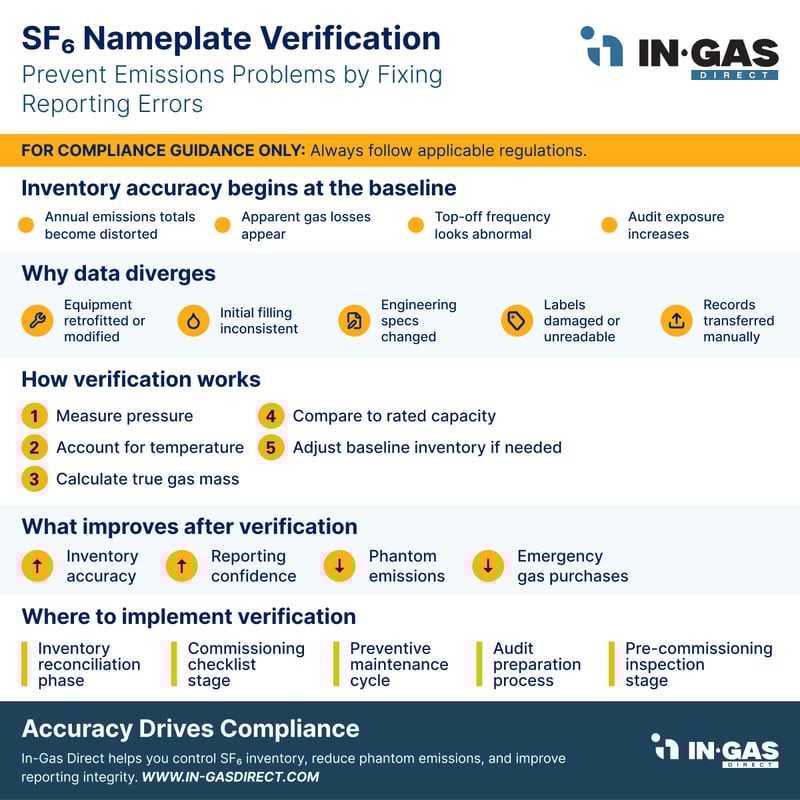
SF₆ nameplate verification is a structured process that compares the nameplate value of an asset with its actual gas content under known conditions. The goal is not to change how equipment operates, but to correct the data used for inventory and emissions tracking.
The process begins with preparation. This includes gathering OEM documentation, reviewing maintenance and gas handling records, and identifying which assets are candidates for verification. High-priority targets often include older switchgear, assets with frequent top-offs, or equipment with an inconsistent reporting history.
Verification itself involves measuring the actual SF₆ gas mass using pressure, temperature, and density data. These measurements are taken under controlled conditions and converted into an equivalent gas mass. That value is then compared to the nameplate figure.
If a discrepancy is found, the verified value becomes the new baseline for inventory and reporting purposes. Importantly, this adjustment does not indicate a leak or failure—it simply corrects historical data so that future emissions calculations are accurate.
Specialized tools and calibrated instruments are required to ensure measurement accuracy. While the process is technical, it is typically completed quickly and at a fraction of the cost of ongoing reporting errors or repeated troubleshooting.
Organizations that lack internal resources often rely on dedicated nameplate verification services to ensure consistency, traceability, and audit-ready documentation.
Integration with Commissioning and Reporting Workflows
One of the most effective ways to prevent future nameplate issues is to integrate verification into existing workflows. During pre-commissioning and commissioning, verification can be included in the commissioning checklist to ensure the baseline inventory is accurate from day one.
For existing assets, verification fits naturally into routine maintenance cycles or targeted data-cleanup initiatives. Once verified, the corrected nameplate data should be updated in all relevant systems, including asset management platforms, gas tracking logs, and emissions reporting tools.
Modern digital platforms make this integration far easier. Options like the Direct-Track SF6 management solution allow verified nameplate data to flow directly into emissions calculations, reducing manual handling and the risk of transcription errors. This creates a single source of truth for SF₆ equipment data across engineering, compliance, and sustainability teams.
Real Challenges and How to Address Them
Despite its benefits, nameplate verification is often delayed due to practical challenges. Human error in historical records, missing documentation, and worn or illegible nameplates are common issues, particularly for legacy equipment.
In some cases, the original nameplate no longer reflects the current configuration of the asset. Retrofitted components, replaced interrupters, or modified gas compartments may have altered the true gas volume without any formal update to the nameplate.
These challenges can be addressed through standardized verification procedures, digital documentation, and technician training. Establishing consistent data capture practices during gas handling and maintenance reduces the likelihood of future discrepancies. Where nameplates are missing or unreadable, verification provides a reliable alternative to guesswork or assumptions.
Benefits Beyond Compliance
While regulatory compliance is a primary driver for SF₆ nameplate verification, the benefits extend well beyond reporting accuracy. Verified nameplate data provides asset managers with greater confidence in equipment health and gas stability.
Unexpected top-off calls often decline once phantom emissions are eliminated. Maintenance planning becomes more predictable, and technicians spend less time investigating false alarms or unexplained inventory changes.
From a sustainability perspective, verification strengthens ESG reporting by ensuring that emissions data reflects reality. This transparency supports internal decision-making, external disclosures, and long-term emissions reduction strategies.
SF₆ nameplate verification is one of the most effective—and underutilized—tools for improving the accuracy of emissions reporting in high-voltage power systems. By aligning reported nameplate data with actual gas content, organizations can eliminate phantom emissions, reduce surprise top-off calls, and establish a defensible baseline for regulatory compliance.
As reporting requirements continue to evolve, verification is no longer a nice-to-have. It is a practical, cost-effective step toward better data integrity, stronger compliance posture, and more sustainable SF₆ management.


Lina Encinias
Lina Encinias holds a B.S. in Environmental Science with a minor in Mass Communications from the University of South Florida. Since joining DILO in 2017, she has combined her technical knowledge with her communication skills to support utilities and industries in safe, compliant, and sustainable gas management. Passionate about environmental stewardship, Lina is dedicated to advancing best practices that protect both people and the planet.